Simple Heart Embroidery Pattern in Three Stitches
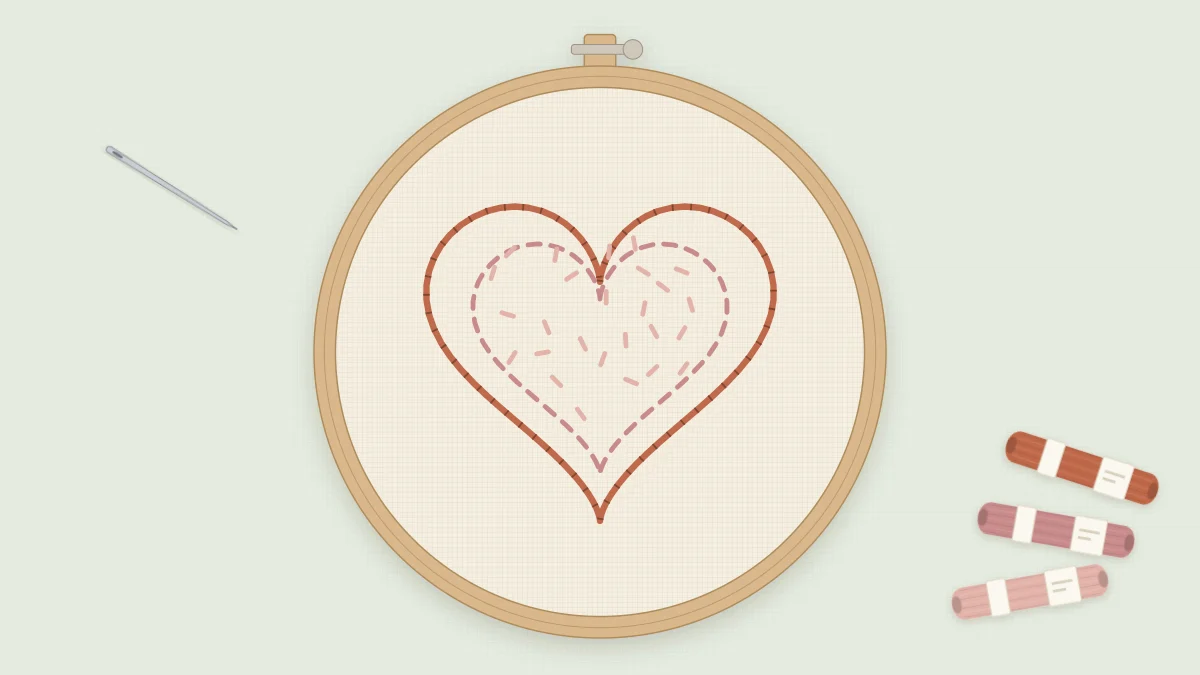
A nested heart for a 4-inch hoop: a backstitch outline, a running stitch echo and a scatter of seed stitch, with no loops and no knots.
Tutorial at a glance
Materials
- 4-inch (10 cm) embroidery hoop
- Cream or white cotton, about 8 in (20 cm) square
- Six-strand cotton floss in terracotta, dusty rose and blush pink
- Embroidery needle for two or three strands
- Small sharp scissors
- Fine water-soluble pen or sharp pencil
- Printed or traced pattern outline
A heart is a good shape to practice on because it contains the three things every outline has: a straight run, a curve and a sharp point. This design uses it to teach three flat stitches with no loops and no knots. A solid backstitch outline is echoed by a dashed running stitch heart inside it, and the middle is sprinkled with seed stitch. It suits a complete beginner, a child learning with an adult, or anyone who wants a small gift that can be finished in an evening.
What You Need
- A 4-inch (10 cm) embroidery hoop
- A square of cream or white cotton, about 8 in (20 cm) on each side
- Six-strand cotton floss in terracotta, dusty rose and blush pink
- An embroidery needle that takes two or three strands comfortably
- Small sharp scissors
- A fine water-soluble pen or a sharp pencil
- The pattern outline below
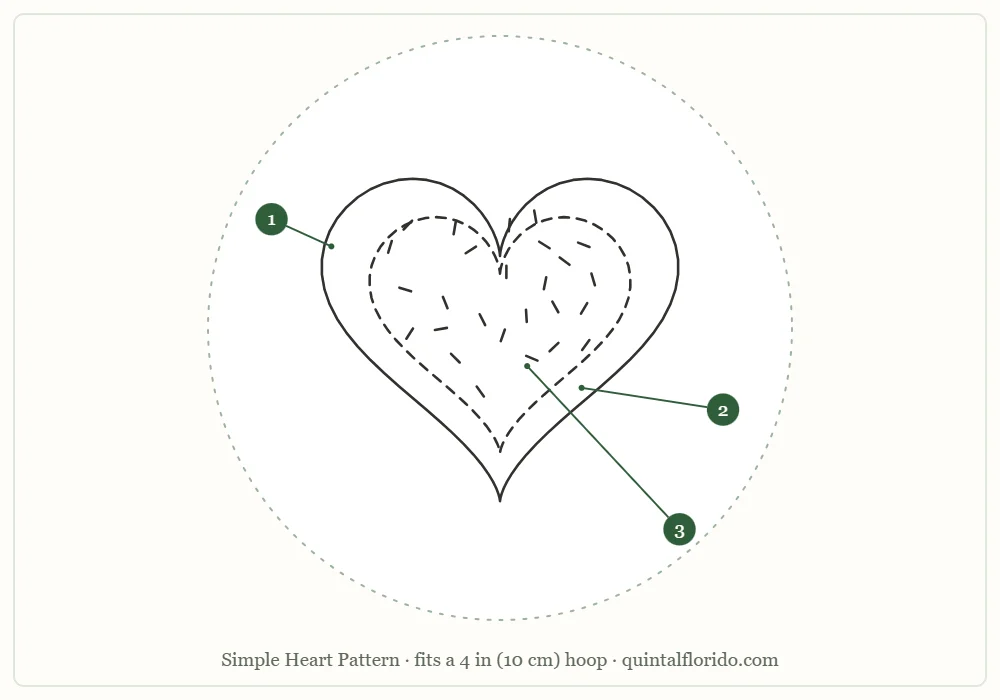
Print the outline or trace it directly from the screen. It can be scaled to fit a different hoop, as long as the heart keeps a clear margin inside the circle.
Stitch and Color Key
| Part | Element | Stitch | Color | Strands |
|---|---|---|---|---|
| 1 | Outer heart outline | Backstitch | Terracotta | 3 |
| 2 | Inner echo heart | Running stitch | Dusty rose | 2 |
| 3 | Scattered fill inside | Seed stitch | Blush pink | 2 |
The three colors step from dark at the edge to pale in the middle, which is what keeps the outline crisp. The guide to planning embroidery colors explains why that light-to-dark order matters more than the exact shades.
Transferring the Design
Cream and white cotton are easy to see through, so trace the design against a window or a lit screen. Draw part 1 as a solid line and part 2 as dashes, exactly as shown, since each dash will become one stitch. Do not draw the seed stitches at all. Marks that small are hard to cover, and the fill looks better when it is placed freely. Use a light hand, because the open center leaves nowhere for a heavy line to hide. All four transfer methods are compared in how to transfer embroidery patterns.
Tip
Before tracing, fold the printed outline in half down the middle of the heart and hold it to the light. If the two lobes do not match after scaling or printing, trace one half, flip the paper and trace the same half again for the other side.
Stitching Order
Hoop the fabric drum-tight with the heart centered. If any of the stitches are new to you, the diagrams in basic embroidery stitches show the needle positions for backstitch and running stitch.
- Part 1, the outer heart, in backstitch. Use three strands of terracotta and start at the bottom point. Come up at A, one stitch length along the line, and go down at B, exactly on the point. Come up at C, one stitch length beyond A, and go back down into A. Continue up one side, around the lobe, into the dip at the top, around the second lobe and back down. Keep stitches about 1/8 in (3 mm) long and shorten them slightly around the top of each lobe. At the dip and at the bottom point, end one stitch exactly on the corner and start the next from that same hole, so the corners stay sharp.
- Part 2, the inner heart, in running stitch. Change to two strands of dusty rose. Come up at the start of a dash, go down at its end, and come up again at the start of the next dash. Work one stitch at a time, straight up and straight down through the taut fabric, and follow the drawn dashes so stitches and gaps stay even. Make sure a stitch, not a gap, lands on the bottom point and in the dip. That keeps the dashed line readable as a heart.
- Part 3, the scattered fill, in seed stitch. Thread two strands of blush pink. Make tiny straight stitches, each about 1/8 in (3 mm) long or a little less, and turn each one to a different angle from its neighbors. Leave roughly one stitch length of bare fabric between them. Start at one side of the inner heart and drift across to the other, staying a small distance inside the dashed line.
- Secure the ends. On the back, slide the needle under several stitches of the outline and trim. Avoid ending threads in the open center, where there is little to weave into.
Watch out
On cream or white cotton, thread carried across the back shows through as a faint shadow. When working the seed stitches, keep each jump on the back under about 1/2 in (12 mm), and never cross the open space between the two hearts with a strand of terracotta.
Common Problems and Fixes
- The bottom point looks rounded. The last stitch on each side stopped short of the corner. Unpick two stitches and bring both sides into the same hole at the tip.
- The lobes look bumpy. The stitches are too long for the curve. Shorten them and the line will follow the drawing more closely.
- The running stitches vary in length. Several stitches were probably loaded onto the needle at once. Go back to one stitch per movement and follow the drawn dashes.
- The seed stitches line up in rows. Turn the hoop a little after every few stitches. Changing your own viewing angle is the easiest way to keep the directions mixed.
- The fill looks patchy. Step back and look at the whole heart, then add single stitches only where the bare areas are largest. It is easier to add than to remove.
- The fabric dimples around the seed stitches. They are pulled too tight. Each one should rest on the surface without denting it.
Variations
- Colors: three values of one color always work, such as three blues or three greens from dark to pale. For a bolder version, stitch all three parts in a single deep red on white.
- Density: a sparse scatter looks airy and modern. A dense scatter, with stitches almost touching, reads nearly as a solid pale fill.
- Size: reduce the heart to about 1 1/2 in (4 cm) for a pocket or a baby bib and drop to two strands for the outline. At that size, leave out either the inner heart or the fill so the design does not crowd.
- Personalize it: skip part 3 and stitch an initial in the center instead. The guide to embroidery lettering basics covers letter height and strand count for small letters.
- Repeat it: a row of three small hearts makes a simple trim along a pillowcase hem or the edge of a tea towel.
Finishing
Rinse the piece in cool water to remove the pen lines, checking the open areas between the two hearts where marks are most visible. Dry it flat and press it face down on a towel. Then center the heart in the hoop again, tighten the screw and trim and gather the spare fabric at the back, following the steps in how to finish the back of an embroidery hoop. A felt backing is worth adding to this design, because it hides the back of the stitching if the hoop is given as a gift.
Frequently asked questions
Which stitches does the heart pattern use?
Backstitch for the outer heart, running stitch for the dashed inner heart and seed stitch for the scattered fill. All three are flat stitches with no loops or knots.
How do I get a sharp point at the bottom of the heart?
End the last stitch of one side exactly on the point and start the other side from that same hole. Stitches that stop short of the corner make it look rounded.
Should I draw the seed stitches on the fabric?
No. Transfer only the two heart lines and place the seed stitches freely, turning each one to a different angle. Tiny drawn marks are hard to cover.
Can I stitch the heart in a different color?
Yes. Three values of any one color work well, from dark for the outline to pale for the fill, or you can stitch all three parts in a single color.