Lavender Embroidery Pattern: A Tied Bunch of Five Stems
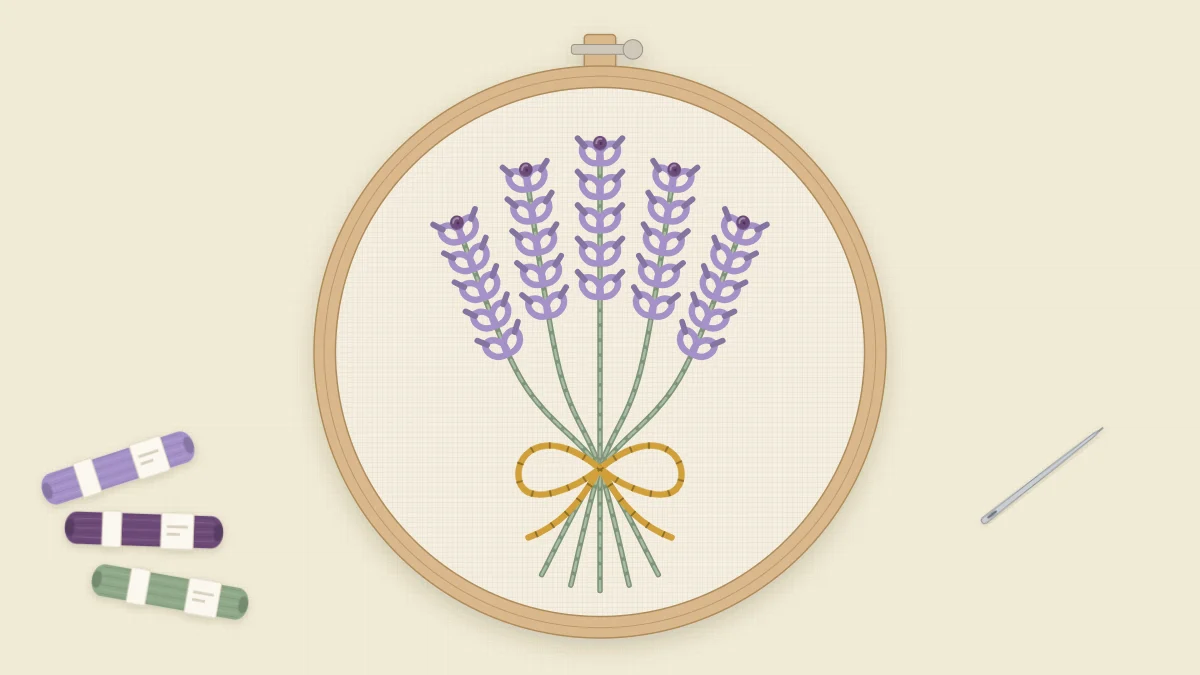
Five lavender stems tied with a bow, for a 5-inch hoop. The pattern practices stem stitch, small lazy daisy buds, French knots and backstitch.
Tutorial at a glance
Materials
- 5-inch (13 cm) embroidery hoop
- White or cream cotton or linen, about 9 in (23 cm) square
- Six-strand cotton floss in sage green, lavender, plum, and cream or mustard
- Embroidery needle with an eye that takes three strands
- Small sharp scissors
- Water-soluble pen
A lavender stem is one of the simplest plants to draw with thread: a thin line, pairs of small buds climbing the top of it, and a single knot at the tip. This pattern gathers five of those stems into a bunch tied with a bow, sized for a 5-inch (13 cm) hoop. It suits beginners who can already work a basic line and want to practice small, repeated lazy daisy stitches, where consistency matters more than speed.
Four stitches are used: stem stitch, lazy daisy, French knot and backstitch. Each one is explained with needle positions in the guide to basic embroidery stitches, which is a useful refresher if the last time you made a French knot was a while ago.
What You Need
- A 5-inch (13 cm) embroidery hoop
- White or cream cotton or linen, about 9 in (23 cm) square
- Six-strand cotton floss in sage green, lavender, plum, and cream or mustard for the bow
- An embroidery needle with an eye that takes three strands comfortably
- Small sharp scissors
- A water-soluble pen
The stems use two strands and everything else uses three. If strand counts are new to you, the embroidery thread guide shows how to separate floss without tangling it.
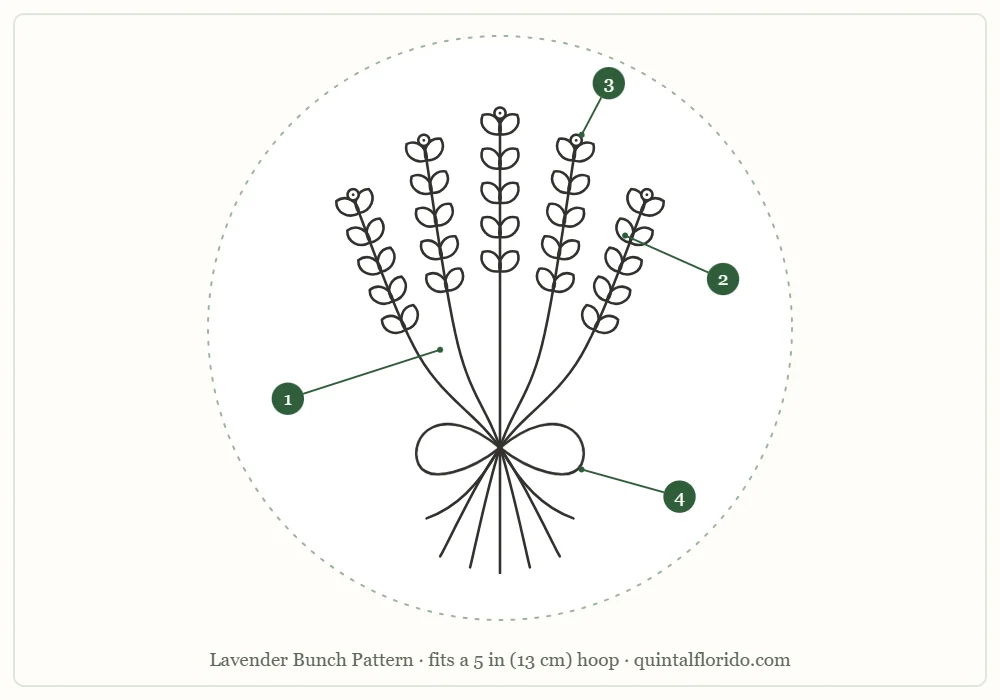
Stitch and Color Key
| Part | Element | Stitch | Color | Strands |
|---|---|---|---|---|
| 1 | Five stems | Stem stitch | Sage green | 2 |
| 2 | Bud pairs along the top of each stem | Lazy daisy, small | Lavender | 3 |
| 3 | Tip bud on each stem | French knot | Plum | 3 |
| 4 | Bow and ties | Backstitch | Cream or mustard | 3 |
For the bow, pick the color that contrasts with your fabric. On white or cream fabric, mustard reads clearly. Cream is the better choice only if you stitch the bunch on a colored fabric.
Transferring the Design
White and cream fabrics are easy to trace through. Tape the outline to a window or a lit screen, lay the fabric on top and draw the five stem lines and the bow with a water-soluble pen. For the buds, a short dash for each one is enough: it tells you where the bud starts on the stem and how far it reaches. Other methods, and which pens wash out, are covered in the guide on how to transfer embroidery patterns.
Place the fabric in the hoop with the tied point of the bunch a little below the center, so the fan of stems has room above it.
Stitching Order
- Stems (part 1). With two strands of sage green, work each stem in stem stitch from the flared end at the bottom, through the tied point, up to the tip. Come up at A, go down at B, and come up at C, halfway back toward A, keeping the working thread on the same side of the needle every time. The five stems cross at the tied point. Stitch straight over the earlier stems there; the bow will cover the crossing.
- Bud pairs (part 2). Change to three strands of lavender. Each bud is a small lazy daisy: come up at A on the stem, go back down at A leaving a loop, come up at B at the bud tip with the needle inside the loop, and anchor the loop with a tiny stitch. Work from the lowest pair upward, one bud to the left and one to the right, each pointing up and away from the stem. Keep them short, about 3/16 in (5 mm).
- Tip buds (part 3). With three strands of plum, make one French knot at the top of each stem. Come up at the very end of the stem line, wrap the floss twice around the needle, and go down right next to where you came up, not into the same hole. Keep the wraps snug against the fabric as the needle passes through.
- Bow and ties (part 4). Backstitch the two bow loops and the two trailing ties with three strands of mustard or cream. Use short stitches, about 1/8 in (3 mm), so the loops stay round. Finish with two or three stitches straight across the tied point to suggest the knot of the ribbon.
Tip
Finish all the bud pairs on one stem before moving to the next. Carrying lavender thread across the back from stem to stem leaves long floats that can show through white fabric.
Getting the Buds Even
The buds are what make the bunch read as lavender, and they look best when each pair matches. Three small habits help:
- Angle every bud the same way, roughly halfway between the stem and a right angle to it.
- Let the pairs sit closer together toward the tip, the way a real flower spike tightens at the top.
- Stop pulling each loop as soon as it lies flat. A small lazy daisy pulled tight turns into a straight line.
Common Problems and Fixes
- The stem line looks like backstitch instead of a rope. The working thread changed sides partway along. Unpick back to the change and keep the thread on one side for the whole stem.
- Buds hide the stem. They are starting on top of the line. Begin each loop just beside the stem so the green stays visible between the pairs.
- A knot slipped through to the back. The needle went down into the hole it came up from. Leave a thread or two of fabric between the two points.
- The bow looks angular. The backstitches are too long for the curve. Halve the stitch length on the tightest part of each loop.
- Puckering around the tied point. Several layers of thread meet there. Tighten the hoop and keep an even, relaxed tension where the stems cross.
Watch out
Dark purples can release dye when wet. Test the plum and lavender floss on a damp scrap of your fabric before rinsing out pen marks on the finished piece.
Variations
- Colors. Swap lavender and plum for two shades of blue for a different wildflower, or use pale pink with a deeper rose tip. On dark fabric, lighten every color by a step so the stems do not sink into the background.
- Fuller spikes. Replace each lazy daisy bud with a French knot in lavender for a denser, more textured stem. It takes longer but hides uneven spacing well.
- A single stem. One stem on its own, about 2 in (5 cm) tall, fits the corner of a napkin, a handkerchief or a small drawstring bag. The guide to embroidered linen napkins shows how to place a small motif on a corner.
- Size. For a 4-inch (10 cm) hoop, reduce the outline and use two strands for the buds as well as the stems.
Finishing
Plan on an evening or two for this piece, since the buds take most of the time. When the stitching is done, rinse out the pen marks in cool water, dry the fabric flat and press it face down on a towel so the knots keep their shape. To frame the bunch in its hoop, follow the steps in the guide on how to finish an embroidery hoop.
Frequently asked questions
What stitch is best for lavender buds?
This pattern uses small lazy daisy stitches in pairs along the top of each stem, with one French knot at the tip. For a denser look, you can replace the lazy daisies with French knots.
How many strands should I use for lavender stems?
Two strands of sage green in stem stitch keep the stems fine. The buds, tip knots and bow use three strands so they stand out against the thinner stems.
Should the bow be cream or mustard?
Choose the one that contrasts with your fabric. Mustard shows clearly on white or cream fabric, while cream suits a colored background.
Which part do I stitch first?
Stitch the five stems first, then the bud pairs, then the tip knots, and the bow last so it covers the point where the stems cross.