Wildflower Wreath Embroidery Pattern for a 6-Inch Hoop
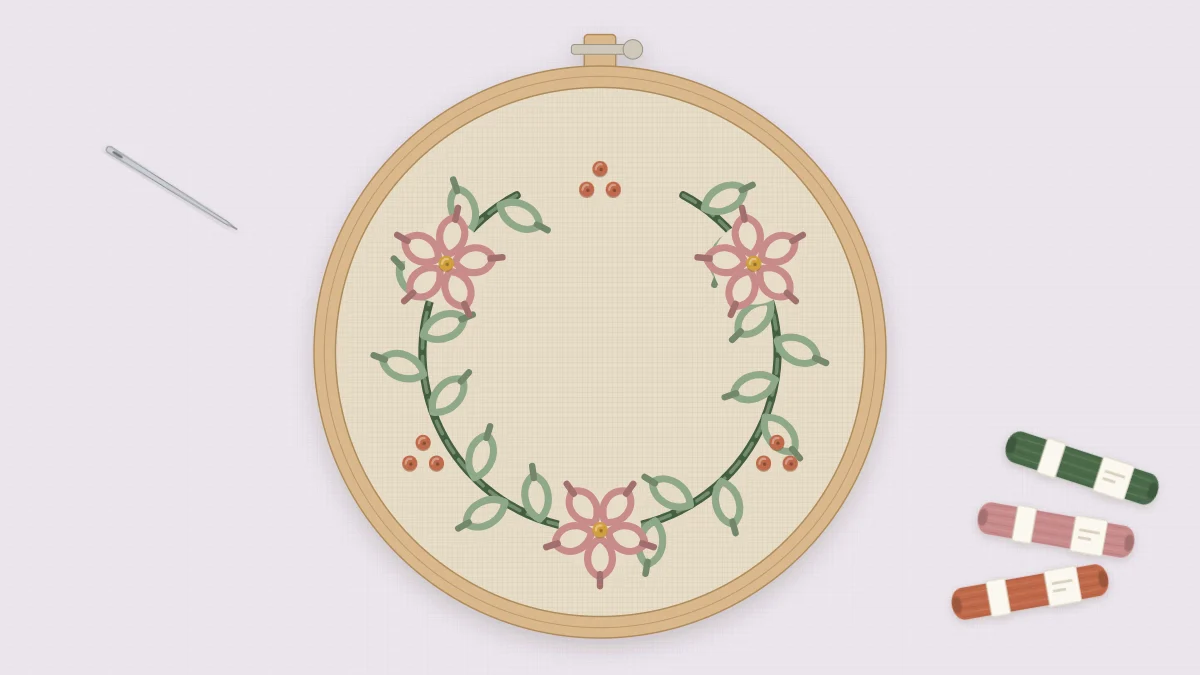
An open wreath of leaves, three five-petal flowers and knot berries for a 6-inch hoop, with a clock-face spacing guide and an empty center for a name or date.
Tutorial at a glance
Materials
- 6-inch (15 cm) embroidery hoop
- Natural linen, about 10 in (25 cm) square
- Six-strand cotton floss in deep green, sage green, dusty rose, mustard and terracotta
- Embroidery needle with an eye that takes three strands
- Small sharp scissors
- Water-soluble pen and a ruler
The difficulty in a wreath is not the stitches. It is spacing: leaves that stay the same size all the way around, flowers that sit at equal distances, and a circle that actually closes where it should. This wildflower wreath for a 6-inch (15 cm) hoop uses only three stitches, yet it is rated intermediate because it asks you to plan the ring before you stitch it. The center is left empty for a name, a date or a single initial.
You should be comfortable with stem stitch, lazy daisy and French knots before starting. If you are not there yet, the easy leaf sprig pattern practices the same leaf and knot on a much smaller scale, and all three stitches are explained in the guide to basic embroidery stitches.
What You Need
- A 6-inch (15 cm) embroidery hoop
- Natural linen, about 10 in (25 cm) square
- Six-strand cotton floss in deep green, sage green, dusty rose, mustard and terracotta
- An embroidery needle with an eye that takes three strands
- Small sharp scissors
- A water-soluble pen and a ruler
The whole design is worked with three strands. The leaves use the most thread, so keep a full skein of sage green on hand.
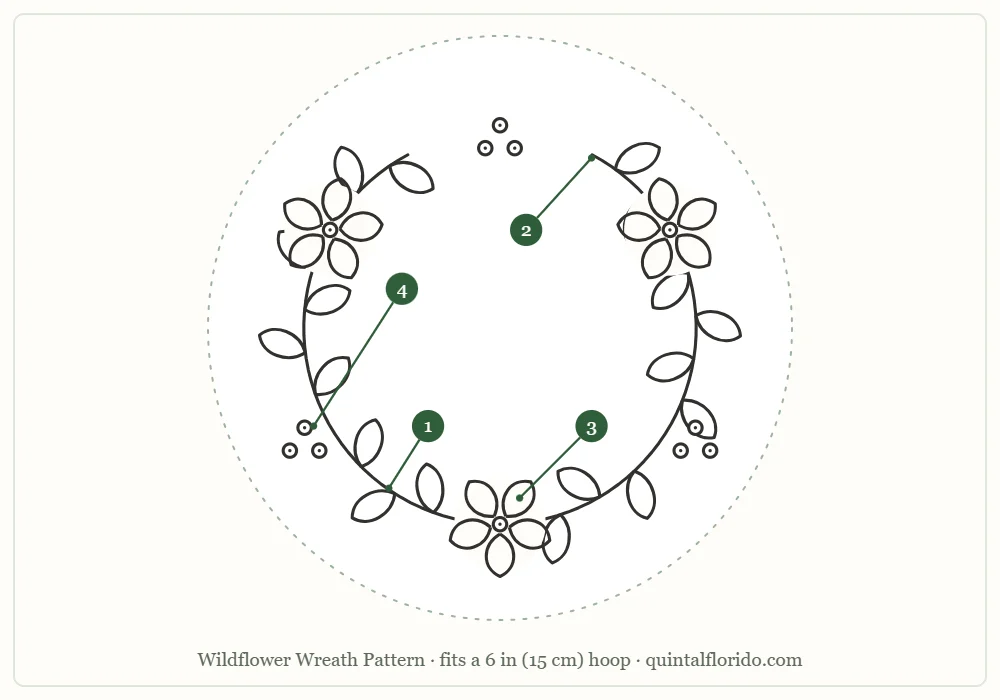
Stitch and Color Key
| Part | Element | Stitch | Color | Strands |
|---|---|---|---|---|
| 1 | Circular vine | Stem stitch | Deep green | 3 |
| 2 | Leaves along the vine | Lazy daisy | Sage green | 3 |
| 3 | Three five-petal flowers | Lazy daisy petals with a French knot center | Dusty rose petals, mustard centers | 3 |
| 4 | Berry clusters of three | French knots | Terracotta | 3 |
Planning the Ring
Think of the wreath as a clock face. The vine is open at the top. The three flowers sit at 2, 6 and 10 o’clock, and the berry clusters sit halfway between them at 4, 8 and 12 o’clock, with the 12 o’clock cluster at the opening in the vine. Leaves fill everything in between, on both sides of the vine.
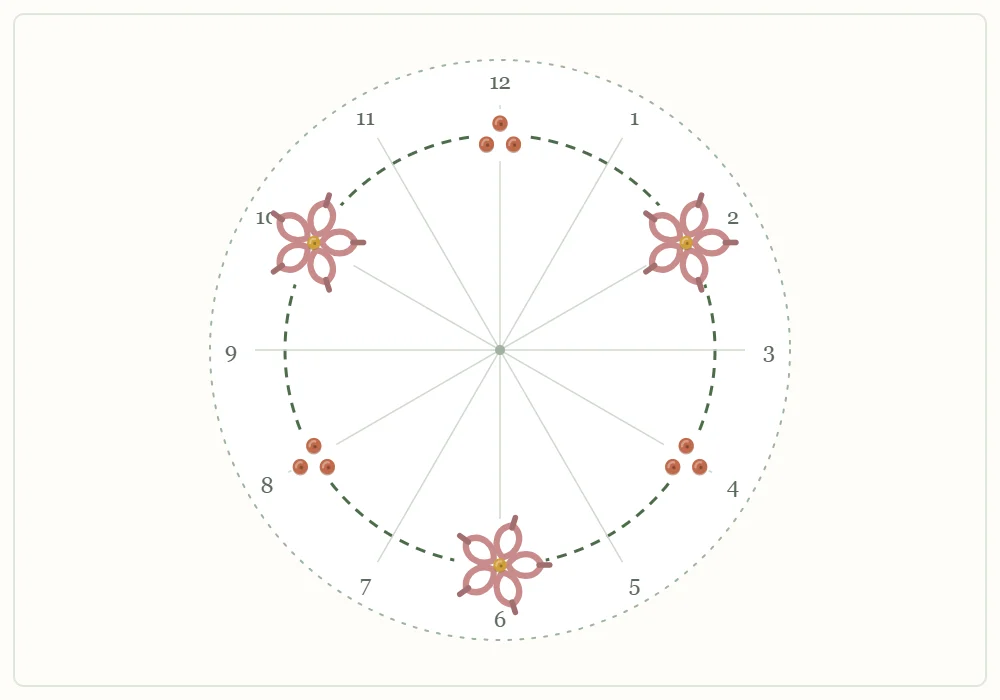
This layout matters most if you resize the pattern or draw the ring freehand. With the six positions marked first, the leaves only need to be spaced evenly within each short section, which is far easier than keeping them even around a whole circle.
Transferring the Design
Natural linen is light enough to trace against a window or a lit screen. Draw the vine as a single line, mark each leaf with a short dash from the vine to the leaf tip, and mark each flower with a dot for the center and five dots for the petal tips. Each berry needs only a dot. If your linen is on the darker side, one of the other methods in the guide on how to transfer embroidery patterns may give a clearer line.
Watch out
Check that the weave of the linen runs straight up and down before tracing. A circle drawn on fabric that is pulled off-grain turns into an oval once the fabric relaxes out of the hoop.
Stitching Order
- Vine (part 1). With three strands of deep green, work stem stitch from one end of the opening at the top, all the way around to the other end. Keep the working thread on the same side of the needle throughout, on the outside of the curve, and use short stitches of about 1/8 in (3 mm) so the circle stays smooth. Stitch straight through the flower positions; the petals will sit over the vine.
- Flowers (part 3). Change to dusty rose. For each petal, come up at A beside the center dot, go back down at A leaving a loop, come up at B at the petal tip inside the loop, and anchor it with a tiny stitch. Work all five petals of one flower, then finish off the thread before moving to the next. Leave the centers for later.
- Leaves (part 2). With sage green, work one lazy daisy per leaf, starting at the vine and ending at the leaf tip. Go around the outside of the ring first, then the inside. All leaves lean the same way around the circle, like a clock hand moving forward. Stop the leaves a little short of each flower and berry position.
- Berries (part 4). With terracotta, make three French knots in a tight triangle at 4, 8 and 12 o’clock. Wrap the floss twice around the needle and go down right next to the point where you came up, not into the same hole.
- Flower centers (part 3). Finish with one mustard French knot in the middle of each flower. Working the knots last keeps them from catching the thread while you stitch around them.
Tip
Turn the hoop as you go so you are always stitching the vine in the direction that feels natural for your hand. The stitch stays the same; only the hoop moves.
Common Problems and Fixes
- Leaves grow or shrink around the ring. Mark every leaf tip before stitching, and compare a new leaf with the one beside it, not with the first one you made.
- The vine looks faceted. The stitches are too long for the curve. Shorten them, and keep each stitch on the drawn line.
- The twist of the stem stitch flips. The working thread moved to the other side of the needle. Unpick back to that point; on a full circle the change is noticeable.
- Petals crowd the center. Start each petal a thread or two away from the center dot so there is room for the knot.
- The fabric puckers. A 6-inch hoop loosens as you work. Retighten it whenever the fabric stops sounding like a drum when tapped. The embroidery hoop guide explains how to keep tension even.
Variations
- Fill the center. Add a name, a date or an initial in backstitch. Draw the lettering on paper first and check that it leaves a clear margin inside the leaves.
- Change the season. Mustard flowers with rust berries give an autumn wreath. White flowers on a dark green or navy fabric, with pale sage leaves, give a winter one.
- Close the ring. Extend the vine across the top and move the 12 o’clock berries onto it for a full circle.
- Use a section. A quarter of the wreath, one flower with leaves on either side, makes a curved motif for a collar or a pocket edge.
Finishing
Expect this piece to take several sittings; the leaves alone are a good evening of stitching. Rinse out the pen marks in cool water, dry the linen flat and press it face down on a towel. The wreath is designed to be displayed in its hoop, and the guide on how to finish an embroidery hoop shows how to close the back neatly.
Frequently asked questions
How do I space the flowers evenly around the wreath?
Treat the ring as a clock face. Place the three flowers at 2, 6 and 10 o'clock and the berry clusters at 4, 8 and 12 o'clock, then fill the sections between them with leaves.
Why is this wreath rated intermediate if the stitches are basic?
The stitches are stem stitch, lazy daisy and French knots, but keeping the leaves the same size and the vine smooth around a full circle takes more control than a small motif.
Can I add a name in the middle of the wreath?
Yes. The center is left empty for a name, date or initial, usually worked in backstitch. Draw the lettering on paper first to check that it fits inside the leaves with a clear margin.
How many strands of floss does the wreath use?
Three strands for every part: the vine, leaves, petals, flower centers and berries.