Embroidery Thread Explained: Floss, Strands, and How Much to Use
How six-strand cotton floss and pearl cotton differ, how to separate strands without tangles, and how many strands to use for outlines, fills, lettering, and knots.
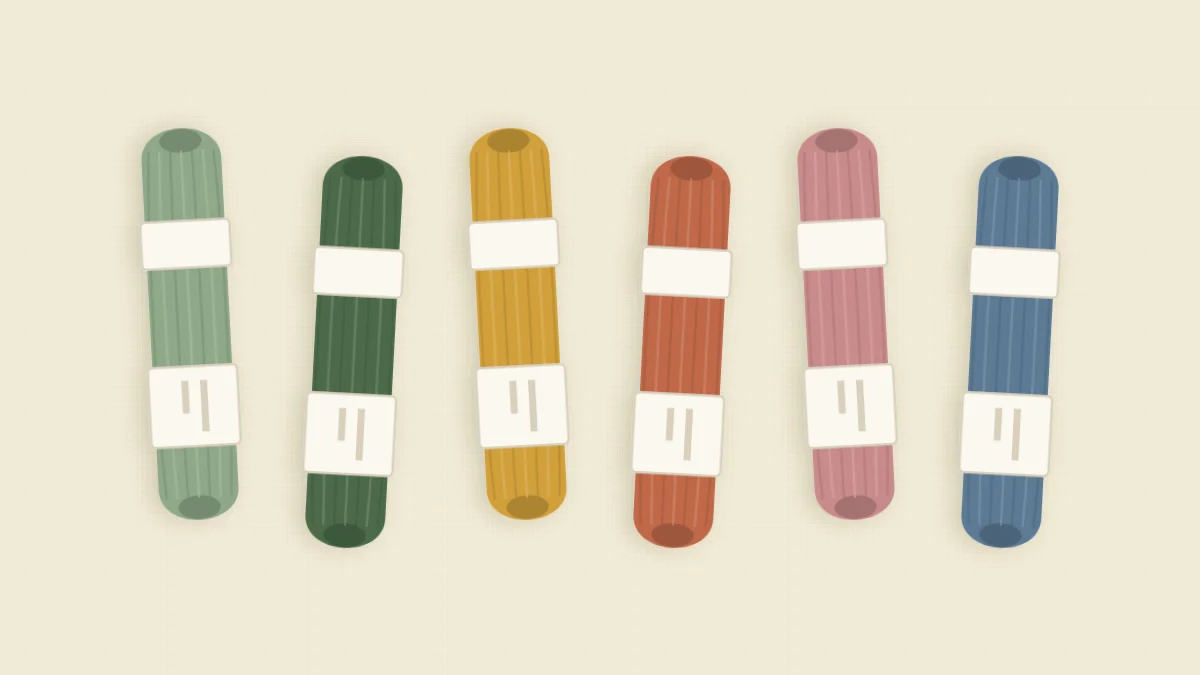
Pick up a skein of embroidery floss and look closely at the cut end: it is not one thread but six fine strands lying loosely together. That detail is the key to the whole craft. By choosing how many of those strands go through the needle, you decide whether a line is hair-fine or bold enough to read from across a room.
Six-Strand Cotton Floss: The Default
Six-strand cotton floss, also called stranded cotton, is what almost every hand embroidery pattern assumes. It has a soft sheen, comes in a very wide color range, and is sold in small skeins of roughly 8 yards (about 8 m). Because the strands separate, a single skein covers every thickness a beginner pattern asks for.
Patterns on this site state a strand count for each part, such as “3 strands” for a stem. That always means strands taken from six-strand floss.
Pearl Cotton
Pearl cotton, also spelled perle, is the other common embroidery thread. It is a single, tightly twisted thread with a rounded shape and a brighter shine, and it is not meant to be divided. It comes in numbered sizes, and the numbering runs backward from what you might expect: a lower number is a thicker thread. The thickest common sizes give a bold, cord-like line, and the finest are close to one or two strands of floss.
Pearl cotton makes neat, raised line stitches and crisp knots, and there is nothing to separate. Floss blends more smoothly in fills such as satin stitch, because its strands spread flat. Starting with floss and adding pearl cotton later is a sensible order.
How to Separate Strands Without Tangling
- Cut a length of floss from the skein.
- Hold it lightly between thumb and forefinger about 1 in (2.5 cm) from one end, and tap the end so the strands fan apart.
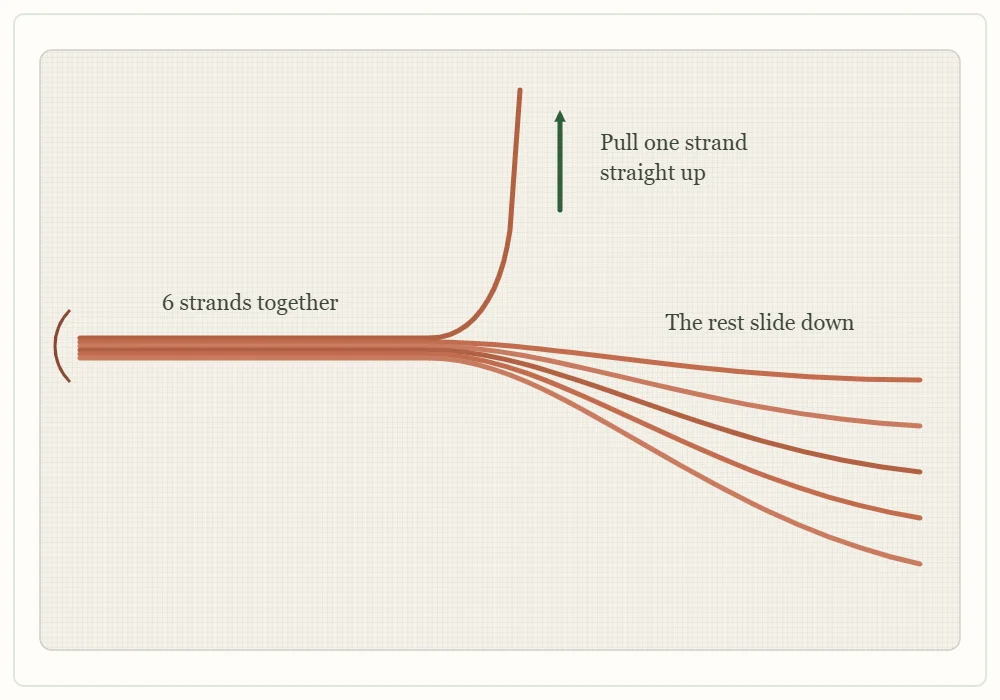
- Pinch a single strand and pull it straight up and out. The remaining strands bunch up beneath your fingers, then drop straight again once the strand is free.
- Repeat until you have the number you need.
- Lay the pulled strands side by side, smooth them together, and thread them through the needle as a group.
Pulling two or three strands away at once is what causes the familiar knot halfway down. Separating them singly and recombining them also lets the strands lie flat and parallel, which gives fuller, smoother coverage.
How Many Strands to Use
| Strands | Look | Good for |
|---|---|---|
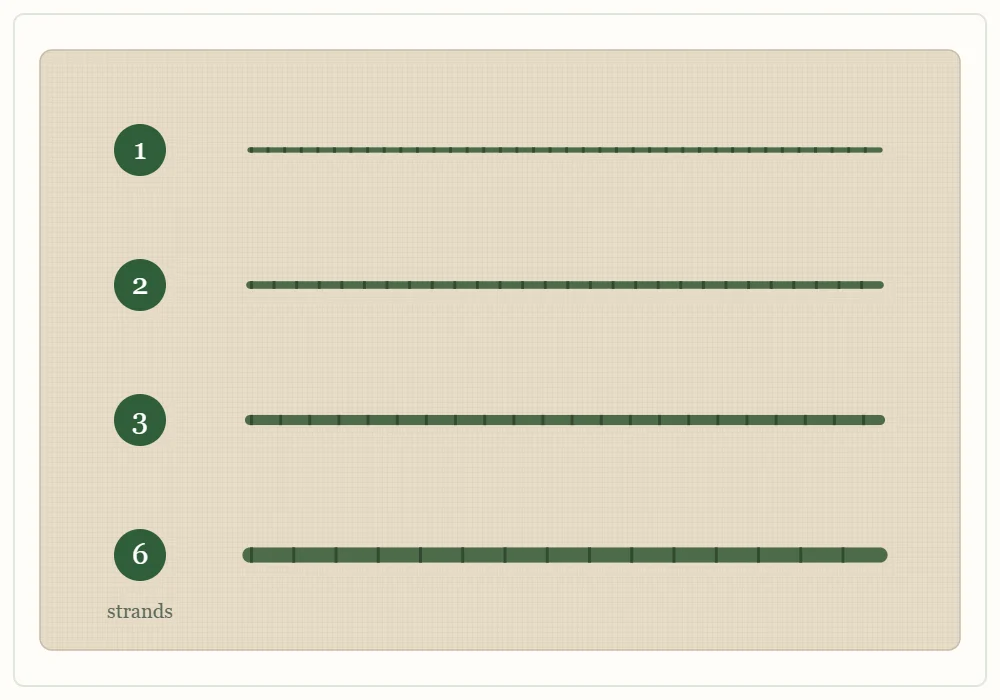
| 1 | Very fine, like a pen line | Tiny details, insect wings, the smallest lettering |
| 2 | Fine but clearly visible | Thin outlines, small lettering, seed stitch, delicate stems |
| 3 | Medium, the all-purpose weight | Most outlines, lazy daisy leaves and petals, French knots, small satin fills |
| 4 | Full and slightly raised | Bolder outlines and larger knots |
| 6 | Thick, textured, rope-like | Chunky lines, woven wheel roses, large knots |
Some rules of thumb by job:
- Outlines: two or three strands. Use fewer on tight curves and small shapes, since thick thread cannot turn sharply.
- Fills: two or three strands for satin stitch. More strands cover faster but lie less smoothly.
- Lettering: one or two strands for small letters, two or three for larger ones. The guide to embroidery lettering matches strand count to letter height.
- Knots: the strand count sets the size of a French knot. Two strands make a pinhead dot and three make a small bead.
All six strands are used undivided in a few places, such as the woven wheel roses, where the bulk is what builds the petals.
Matching the Needle to the Thread
Embroidery needles have a sharp point and a long eye, and they come in a range of sizes. The principle is simple: more strands need a larger eye. The needle has to open a hole in the fabric wide enough for the doubled thread at the eye to follow without a tug.
- If threading is a struggle, or you hear and feel the thread drag at every stitch, the needle is too small.
- If the needle leaves visible holes around a thin thread, it is too large.
A mixed pack covers everything from one strand to six. Pick the finest needle that threads without a fight.
Thread Length, Twisting, and Knots
Cut floss to about 18 in (45 cm), roughly the length of your forearm. Every stitch drags the thread through the fabric, and a long piece is dull, fuzzy, and thin by the time you reach its end. A long piece also tangles more.
Thread twists gradually as you stitch. When it starts to kink or the strands separate into a rope, turn the hoop over and let the needle dangle until it stops spinning. Then slide the needle back to its position and carry on.
Tip
When a loop knots itself on the back, do not pull harder. Slip the tip of the needle into the loop and tease it open gently. Most of these knots are simple slip loops that release with a light pull on one side.
Pulling the thread through slowly for the last few inches of each stitch prevents most tangles. For the basics of starting and ending a length, see how to start hand embroidery.
Storing Floss
A skein pulled from the wrong end collapses into a tangle. Leave the paper bands on, find the tail that slides out freely when tugged gently, and pull from there. If it resists, try the other end.
For longer-term storage, wind each skein onto a flat card or plastic bobbin and write the color name on it. Bobbins stand upright in a shallow box, stay tidy, and make it easy to lay colors next to each other when you are planning a palette. Leftover cut strands can be looped through holes punched along the edge of a card, one hole per color. Keep floss away from direct sunlight, which fades it over time.
Colorfastness: Test Reds and Darks
Good-quality cotton floss is generally colorfast, but strong reds, dark blues, purples, and blacks are the shades most likely to release dye when wet. A stain that bleeds into pale fabric is very hard to remove, so a short test is worth it for any piece that will be rinsed or washed.
- Cut a short length of the thread.
- Wet it thoroughly with warm water.
- Press it between two layers of white paper towel or white cotton and leave it for a few minutes.
- Check the towel. Any tint means the thread may bleed.
Watch out
If a thread leaves color on the towel, do not use it on anything that will be washed, such as napkins or clothing. On hoop art, choose a transfer method that needs no rinsing.
Putting It Together
For a first project, three skeins of six-strand cotton floss, a mixed pack of embroidery needles, and the habit of pulling strands one at a time are all that is needed. Work with three strands until the stitches feel steady, then try the same line with two and with six to see the difference for yourself. The eight stitches in the basic stitch guide are a good place to run that experiment.
Frequently asked questions
How many strands of embroidery floss should I use?
Three strands suit most outlines, leaves, and knots. Use one or two for fine details and small lettering, and all six for thick, textured lines.
How do I separate embroidery floss without it tangling?
Hold the cut length near one end and pull out a single strand straight up. Repeat for each strand you need, then lay them together again before threading.
What is the difference between embroidery floss and pearl cotton?
Floss is six loose strands that can be divided to change the thickness. Pearl cotton is a single twisted thread that is not divided and comes in numbered sizes, where a lower number is thicker.
Will embroidery floss bleed when washed?
Good-quality cotton floss is generally colorfast, but strong reds and dark shades are the most likely to release dye. Wet a short piece and press it on white paper towel to check before using it on anything washable.