Best Fabric for Hand Embroidery: A Practical Guide
Why medium-weight, non-stretch cotton and linen are easiest to stitch, how canvas, denim, and felt compare, and how to prewash, cut, and find the grain.
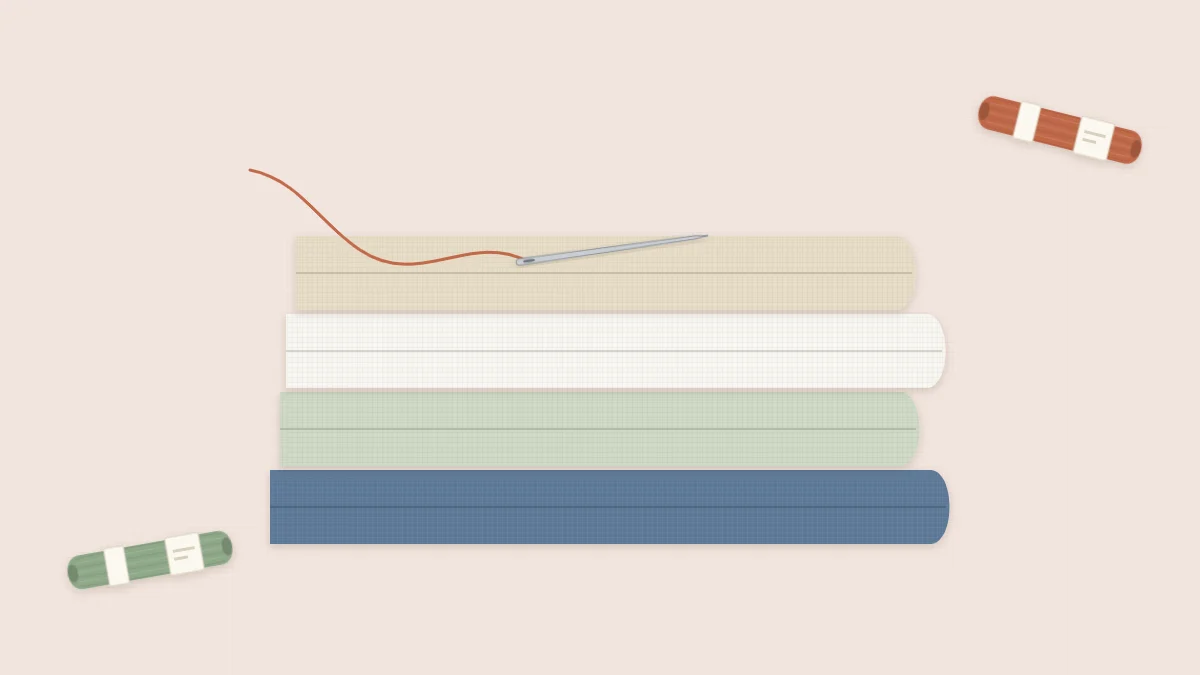
The easiest fabric to embroider is a medium-weight, non-stretch cotton or linen in a plain weave. That one sentence answers most beginner questions, but it helps to know why, because the same reasoning tells you how any other fabric will behave before you put a needle into it.
What Makes a Fabric Easy to Stitch
Three properties matter more than the fiber itself.
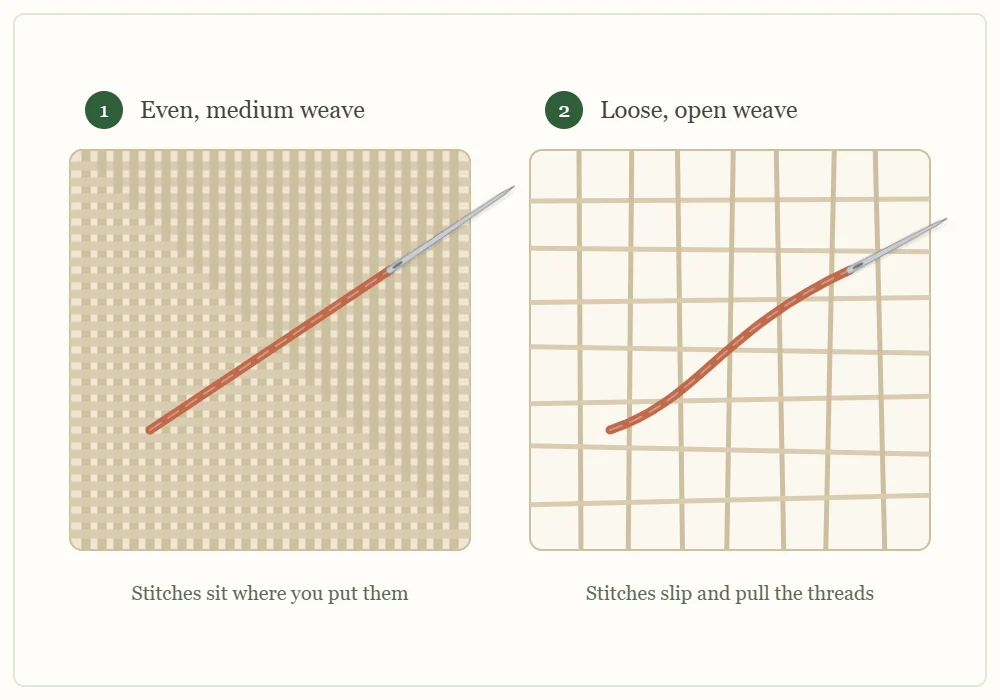
- An even plain weave. In a plain weave, threads cross over and under one another in a simple grid. The needle slips between threads instead of piercing them, and stitches can land anywhere you want them.
- Medium weight. The fabric should be heavy enough to support the stitches without puckering and light enough that the needle passes through with little effort.
- No stretch. A stable fabric keeps its shape in the hoop, so the design looks the same when it comes out as it did when it went in.
Common Fabrics Compared
| Fabric | How it stitches | Good for | Keep in mind |
|---|---|---|---|
| Quilting cotton | Smooth and predictable | First projects, hoop art, fine detail | Thin enough that dark threads carried across the back can show |
| Muslin (calico) | Soft and easy, slightly looser | Practice pieces and stitch samplers | Lightweight kinds pucker under dense stitching |
| Linen and linen blends | Crisp, with visible texture | Hoop art, napkins, table linen | Creases easily and frays at cut edges |
| Cotton canvas | Firm, takes more effort to pull through | Tote bags, pouches, cushions | Needs a sturdy needle with a sharp point |
| Denim | Tough and stable | Jackets, pockets, patches | Too thick to trace through; a thimble helps |
| Felt | Soft, with no weave to follow | Ornaments, patches, small shapes | Pens drag on the surface; edges do not fray |
Cotton
Quilting cotton is the most forgiving place to start. It is smooth, tightly but not densely woven, inexpensive, and sold in a wide range of solid colors. Muslin, called calico in some countries, is plainer and usually unbleached. It makes a good practice cloth, though the thinnest grades are too flimsy for heavier stitching.
Linen and linen blends
Linen has a slightly irregular thread and a natural color that suits botanical designs. Pure linen is pleasant to stitch but can be loosely woven, so look for a medium weight where the threads sit close together. Linen and cotton blends are a little smoother, crease less, and often cost less.
Canvas and denim
Both are sturdy enough to stitch without much risk of puckering, and both are thick enough that each stitch takes a firm push and pull. Use shorter lengths of thread, since the rough passage wears floss faster. Stiff canvas and denim can sometimes be stitched without a hoop at all.
Felt
Felt is pressed fiber rather than woven thread, so it does not fray and can be cut to any shape. Wool and wool-blend felt is denser and holds stitches better than thin craft felt, which can stretch and tear around the needle holes.
Fabrics That Make Things Harder
- Stretch knits, such as T-shirt jersey, distort in the hoop and spring back afterward, which puckers the stitching. They can be embroidered, but they need a stabilizer behind them. See how to embroider on clothing for the method.
- Very loose weaves, such as gauze or open-weave linen, leave gaps for stitches to fall into. Small stitches and French knots can disappear through to the back.
- Very tight weaves, such as high-thread-count sheeting, resist the needle. Each stitch takes effort, and the needle can leave visible holes if you need to unpick.
- Slippery or very sheer fabrics shift in the hoop and show every thread on the back.
Should You Prewash?
Cotton and linen can shrink the first time they are washed. If the fabric shrinks after it has been embroidered, the stitches do not shrink with it, and the surface puckers.
- Always prewash anything that will be washed later: napkins, tea towels, clothing, pillowcases. Wash and dry it the way the finished item will be cared for, then press it.
- For hoop art, prewashing is optional, since the piece will only be rinsed once to remove transfer marks. It does remove the stiff finish some fabrics are sold with.
The project on embroidering linen napkins shows the full routine for a piece that will be laundered often.
Cutting the Fabric and Finding the Grain
Cut a square equal to the hoop size plus about 2 in (5 cm) on each side. For a 4-inch (10 cm) hoop, that is a square of about 8 in (20 cm). The margin gives the hoop something to grip and leaves enough fabric to gather at the back when the piece is finished. The embroidery hoop guide explains how to tension it.
The grain is the direction of the woven threads. One set runs the length of the fabric, parallel to the finished edge called the selvage, and the other runs across. The diagonal between them is the bias, which stretches.
- Look closely at the fabric, or snip into the edge and pull out a single thread. The line it leaves shows the grain.
- Cut along that line so the edges of the square follow the threads.
- Place the design so its vertical axis runs along the grain, not at a slant.
- Hoop the fabric with the threads running straight up and down and straight across.
A design set on the straight grain stays in shape. One set at a slant can stretch along the bias in the hoop and look skewed later.
Tip
Linen and loosely woven cotton fray as you handle them. An extra 1/2 in (12 mm) of margin costs almost nothing and saves the working edge from unraveling into the hoop area.
Light or Dark Fabric
Color changes two things: how you transfer the design and how the thread reads.
White, cream, and natural linen can be traced over a window or light pad, which is the simplest method. Navy, black, and thick fabrics block the light, so the design has to be applied on top. The guide to transferring embroidery patterns covers the options for each.
Thread color behaves differently too. Mid-tone greens and blues that stand out on cream can almost vanish on navy, while white, cream, and mustard glow. The moon and stars pattern is designed for dark cotton and is a good first try at it.
Watch out
White thread on white or cream fabric gives very little contrast. For white flowers or snowflakes, choose a colored or natural linen ground so the stitches can be seen.
A Simple Rule for Choosing
Hold the fabric up to the light and pull it gently in both directions. If the weave looks even, the threads sit close together, and it does not stretch along the straight grain, it will embroider well. For a first hoop, a light-colored quilting cotton or a medium-weight linen blend meets all three tests.
Frequently asked questions
What is the best fabric for a beginner to embroider on?
A light-colored, medium-weight quilting cotton or linen blend with no stretch. The even plain weave lets the needle pass easily and holds stitches where you place them.
Do I need to prewash fabric before embroidering?
Prewash anything that will be washed later, such as napkins, towels, and clothing, so it does not shrink under the stitches. For hoop art it is optional.
How big should I cut fabric for an embroidery hoop?
Cut a square equal to the hoop size plus about 2 in (5 cm) on each side. For a 4-inch (10 cm) hoop, that is about 8 in (20 cm) square.
Can I embroider on stretchy fabric?
Yes, but stretch knits distort in the hoop and pucker afterward unless a stabilizer is used behind them. A non-stretch woven fabric is much easier to learn on.