Woven Wheel Rose Embroidery Pattern: Three Roses, Step by Step
Three woven wheel roses with satin stitch leaves and knot buds for a 5-inch hoop, with a clear explanation of why the wheel needs five spokes.
Tutorial at a glance
Materials
- 5-inch (13 cm) embroidery hoop
- Cream cotton or linen, about 9 in (23 cm) square
- Six-strand cotton floss in dusty rose, blush pink, terracotta, deep green and mustard
- Embroidery needle with an eye large enough for six strands
- Blunt tapestry needle for weaving (optional)
- Small sharp scissors
- Water-soluble pen
A woven wheel rose is built on an odd number of spokes, and that one rule explains the whole stitch. You weave the thread over one spoke and under the next, around and around. With five spokes, each new round lands opposite the round before it: where the thread went over, it now goes under. The rounds stack into overlapping petals. With an even number of spokes, every round would repeat the same path and the thread would simply pile up in ridges.
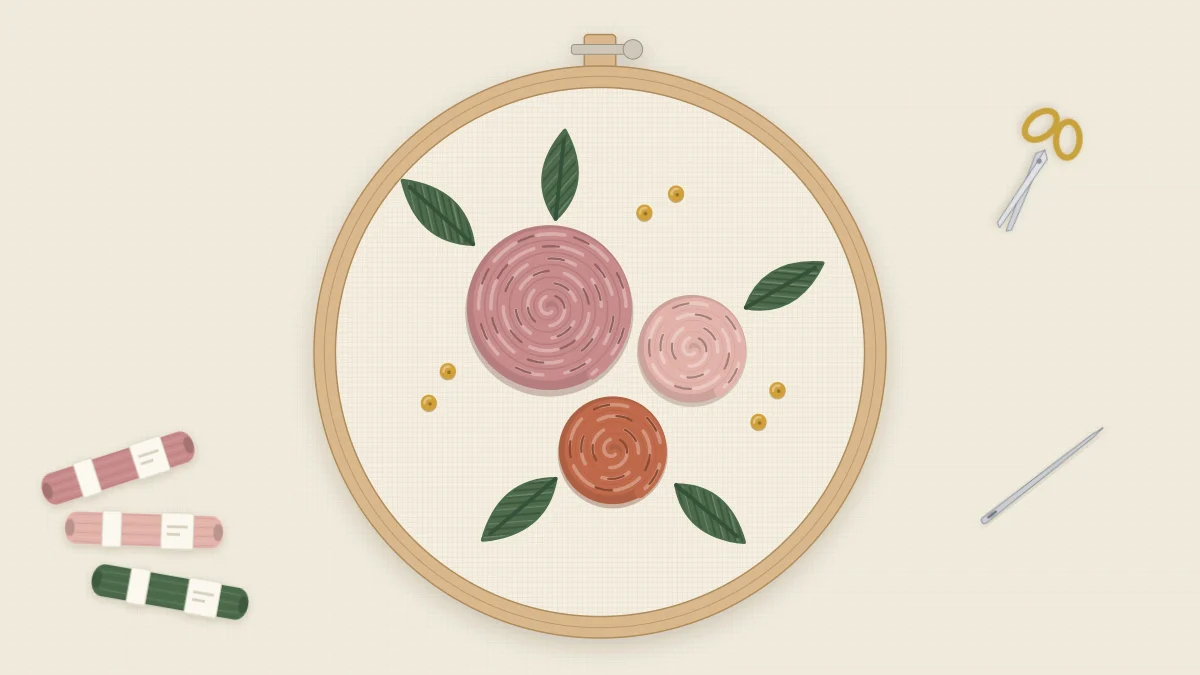
This pattern groups three roses in a loose triangle, one large and two smaller, with five satin stitch leaves and a few knot buds around them. It is rated intermediate. The weaving is forgiving, but the leaves ask for a steady satin stitch. If satin stitch or French knots are new to you, read through the guide to basic embroidery stitches first.
What You Need
- A 5-inch (13 cm) embroidery hoop
- Cream cotton or linen, about 9 in (23 cm) square
- Six-strand cotton floss in dusty rose, blush pink, terracotta, deep green and mustard
- An embroidery needle with an eye large enough for all six strands
- A blunt tapestry needle for the weaving (optional but helpful)
- Small sharp scissors
- A water-soluble pen
The roses use all six strands, straight from the skein, so they go through floss quickly. Cut a longer length than usual for the large rose, about 30 in (75 cm), so you can finish the weaving without joining a new thread.
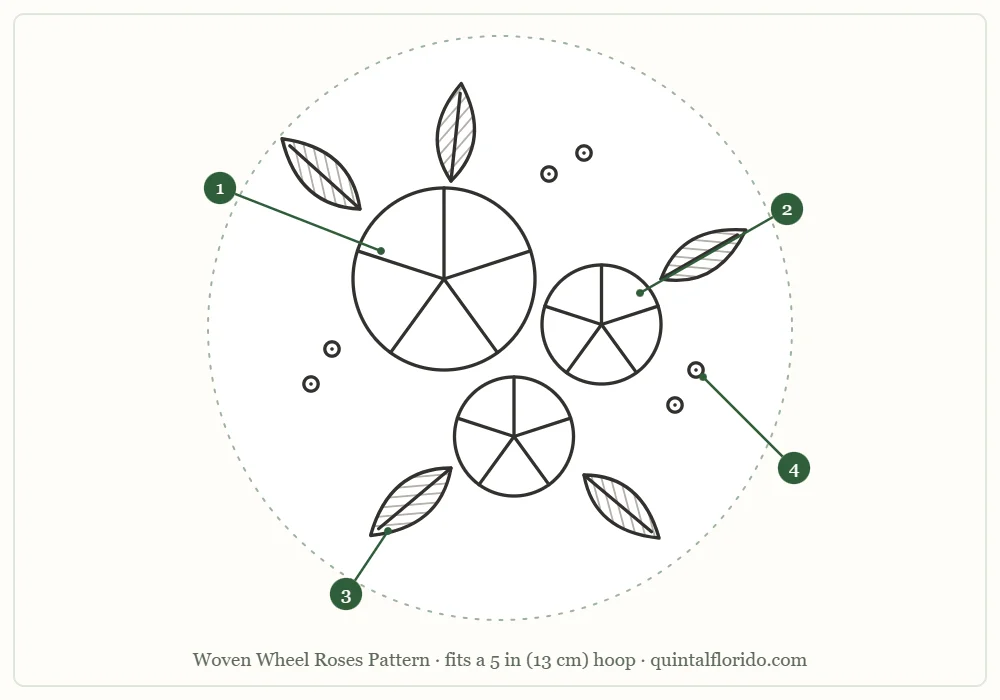
Stitch and Color Key
| Part | Element | Stitch | Color | Strands |
|---|---|---|---|---|
| 1 | Large rose | Woven wheel on five spokes | Dusty rose | 6 |
| 2 | Two smaller roses | Woven wheel on five spokes | Blush pink and terracotta | 6 |
| 3 | Five leaves | Satin stitch worked in two halves with a center line | Deep green | 3 |
| 4 | Buds between the leaves | French knots | Mustard | 3 |
Transferring the Design
Trace the outline onto the cream fabric against a window or a lit screen. For each rose, draw the circle and its five spokes; the spokes must be evenly spaced, like the arms of a star. For each leaf, draw the outline and the center line. The buds need only a dot. The roses will cover their own guidelines completely, but the leaf outlines sit at the edge of the stitching, so keep those lines fine. The guide on how to transfer embroidery patterns compares the marking tools that wash out.
How the Woven Wheel Works
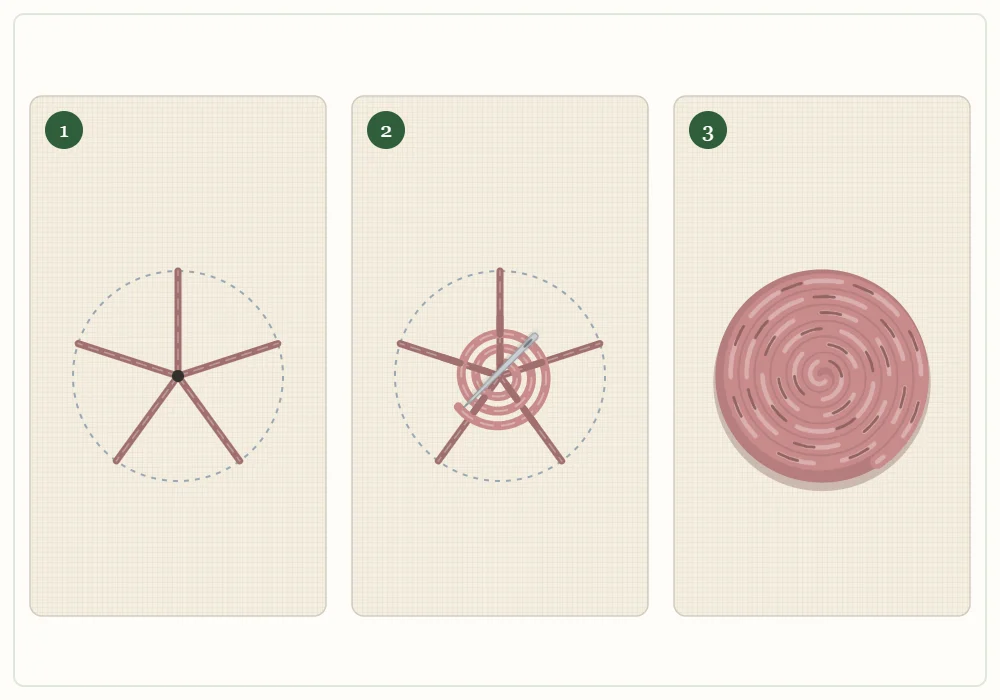
- Stitch the spokes. Make five straight stitches, each one from the edge of the circle to the center. Pull them firm so they lie flat, and secure the thread on the back. The spokes carry the whole rose, so they should not be slack.
- Start weaving. Bring the needle up close to the center, between two spokes. From here on the needle does not go through the fabric until the rose is finished.
- Go over and under. Slide the needle over the first spoke and under the next, and keep going around the wheel. A blunt tapestry needle, or a sharp needle pushed eye-first, slips under the spokes without splitting them.
- Loosen as you go. Pull the first two rounds snug so the center is tight. After that, let each round sit loosely against the one before it. Let the six strands twist a little; this gives the petals their rolled look.
- Finish. When the spokes are hidden and the circle is full, take the needle down under the edge of the last round and fasten off on the back.
Watch out
Count the spokes before you weave. Four or six spokes will not work: the thread follows the same over-and-under path every round and never forms petals. Five is the number drawn on this pattern.
Stitching Order
- Leaves (part 3). Work the five leaves first, with three strands of deep green. Fill one half of a leaf with slanted satin stitches that run from the center line out to the edge, then fill the other half the same way, slanting in the mirror direction. The two halves meet along the center line and form a vein. Start each half at the tip and keep the stitches parallel and close together.
- Buds (part 4). With three strands of mustard, make a French knot on each bud dot. Wrap the floss twice around the needle and go down right next to the point where you came up, not into the same hole.
- Smaller roses (part 2). Work one in blush pink and one in terracotta, six strands each. Starting with the smaller roses lets you get the feel of the weaving before the large one.
- Large rose (part 1). Finish with the large rose in six strands of dusty rose. The roses go in last because they are raised and would catch the thread while you stitch the flat parts around them.
Tip
If the thread runs out mid-rose, take it down to the back under the woven petals and fasten off. Bring the new thread up in the same place and carry on with the over-and-under sequence where you stopped.
Common Problems and Fixes
- Spokes still show at the edge. The rose needs one or two more rounds. Keep weaving until the outer round sits just past the ends of the spokes.
- The rose is flat and tight. The outer rounds were pulled too hard. Unweave back a few rounds and let the thread rest loosely.
- The weaving skipped a spoke. Going over two spokes in a row leaves a visible gap. Back the needle out to the mistake and correct it; nothing is anchored in the fabric, so unweaving is quick.
- Gaps in the leaves. The satin stitches are too far apart. Slip an extra stitch into each gap, and place the next stitches right against the previous one.
- A ragged leaf edge. Bring the needle up exactly on the drawn outline every time, not just inside it.
Variations
- Colors. Three shades of one color, light to dark, give a calmer bouquet. Mustard, cream and rust turn the roses into autumn blooms. The guide to embroidery color planning explains how to check that three shades are far enough apart.
- Thread. Pearl cotton gives a rounder, more defined petal than six-strand floss.
- Size. Smaller circles need fewer rounds. For a very small rose, use three or four strands on five spokes.
- Single rose. One rose with two leaves works as a small motif, though the raised petals suit hoop art and decorative pieces better than items that are washed often.
Finishing
Plan on two or three evenings, with the leaves taking most of that time. Rinse out the pen marks in cool water and dry the fabric flat. Press only around the roses, face down on a thick folded towel, so the petals are not crushed. Then close the back of the hoop as described in the guide on how to finish an embroidery hoop.
Frequently asked questions
Why does a woven wheel rose need an odd number of spokes?
With an odd number, each round of weaving goes under the spokes the previous round went over, so the rounds overlap like petals. With an even number, every round follows the same path and the rose never forms.
How many strands of floss should I use for a woven wheel rose?
This pattern uses all six strands for both the spokes and the weaving, which fills the circle quickly and gives full petals. Very small roses can be worked with three or four strands.
Does the needle go through the fabric while weaving?
No. After the needle comes up near the center, it only passes over and under the spokes. It goes back through the fabric once, under the edge of the last round, to finish.
What do I do if the thread runs out in the middle of a rose?
Take the thread to the back under the woven petals and fasten off, then bring a new thread up in the same spot and continue the over-and-under sequence.